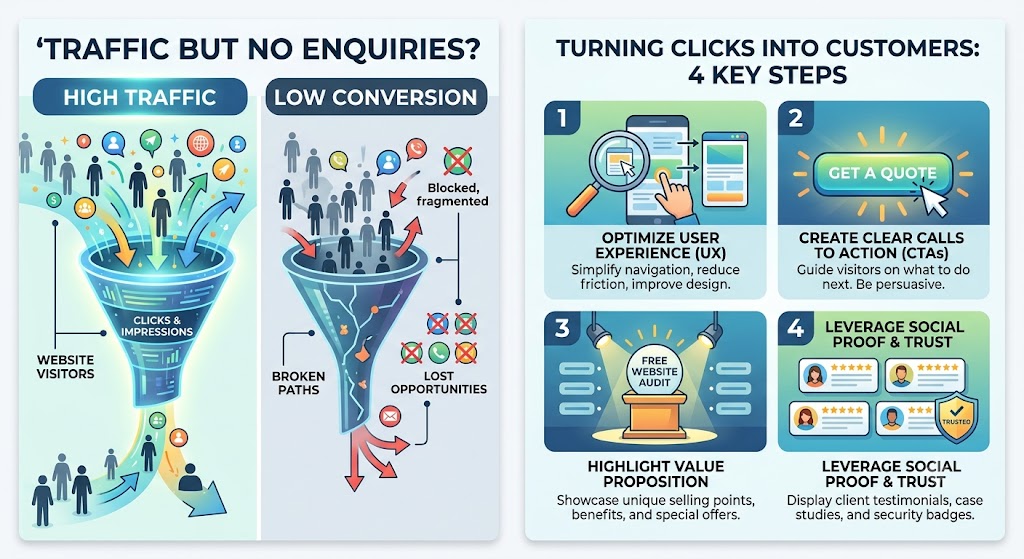
This is one of the most frustrating challenges a business owner can face: high traffic, zero conversions.
If your website attracts visitors but fails to turn them into inquiries, the problem isn't your marketing—it is what happens after people land on your site. Here are the core reasons why your traffic isn't converting and how to turn those silent visits into active leads.
1. Your Value Proposition Is Hidden (or Missing)
When a user lands on your website, you have less than five seconds to answer three critical questions:
- What do you do?
- How does it help me?
- What should I do next?
If your homepage or landing page uses generic jargon like "We deliver innovative, paradigm-shifting solutions," visitors won't stick around to figure out what you actually offer. Speak directly to their pain points with clear, simple language.
2. Friction in the Conversion Path
Even when visitors want to reach out, a confusing user interface can stop them in their tracks.
- Too Many Form Fields: Asking for a phone number, address, company size, and budget on an initial contact form creates unnecessary resistance. Keep initial forms short—often just a name, email, and a message box are enough.
- Hard-to-Find Contact Info: If a user has to scroll through three sub-pages just to find a phone number or email address, they will likely leave and head to a competitor. Keep a clear "Contact" button visible in your main navigation menu.
Pro Tip: Test your contact form once a month. You would be surprised how often a silent inbox isn't a lack of interest, but a broken script, a failed plugin update, or an email routing error. Set a recurring reminder on your calendar to fill out and submit your own website contact forms regularly to ensure every inquiry actually reaches your inbox.
3. Poor Mobile Experience
Over half of global web traffic comes from mobile devices. If your desktop site looks stunning but your mobile layout breaks, buttons are too small to tap, or forms zoom in awkwardly, mobile users will abandon ship immediately.
Responsive design isn't just about making things shrink to fit a smartphone screen—it's about re-engineering the user journey so reaching out is effortless on a touchscreen.
4. Lack of Trust Signals
Online visitors are naturally skeptical. Before someone fills out a form or shares their contact details, they need proof that your business is legitimate and trustworthy.
Make sure your high-traffic pages include:
- Client Testimonials & Case Studies: Show real results from past projects.
- Social Proof: Include logos of clients you have worked with or certifications you hold.
- Clear Policy Links: Simple footers with privacy policies and terms build baseline trust.
5. Weak or Confusing Calls to Action (CTAs)
A passive website produces passive visitors. If your pages end without a clear next step, visitors will simply close the tab.
Instead of vague buttons like "Submit" or "Learn More," use action-oriented language that highlights the value of taking action:
- "Get a Free Website Audit"
- "Request a Custom Quote"
- "Schedule a Strategy Call"
Keep your primary CTA prominent on every key page so visitors never have to guess what to do next.
Turn Your Clicks Into Clients
High web traffic is a great asset, but traffic alone doesn't pay the bills—conversions do. By eliminating design friction, strengthening your messaging, building trust, and verifying that your technical setups are working smoothly, you can transform your website from a passive digital brochure into a lead-generating engine.
Need help optimizing your website’s user experience and layout to convert more visitors? Reach out to the web design and development experts at Dots & Coms.